Why your glasses prescription does not translate directly
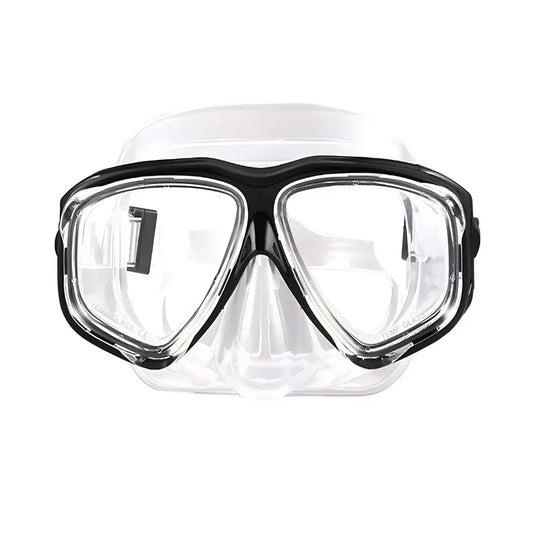
Most prescription snorkel masks and prescription scuba masks use ready-made single-vision lenses. These correct sphere only. If your prescription includes cylinder for astigmatism, those lenses cannot directly correct it.
On top of that, water naturally magnifies your vision. Objects underwater appear larger and closer than they actually are. This means the lens strength that works perfectly on land may feel too strong in the water.
So you have two separate adjustments to think about: accounting for the fact that these are sphere-only lenses, and accounting for underwater magnification. That is what we wanted to test.
Understanding your prescription
Before getting into the results, here is a quick explanation of what the numbers on your prescription mean for choosing mask lenses.
Sphere (SPH) is the main correction value. Negative numbers indicate nearsightedness. Positive numbers indicate farsightedness. This is the value most directly relevant to choosing your lens strength.
Cylinder (CYL) corrects astigmatism. Our lenses cannot correct this directly. The question is whether and how you should account for it when choosing your sphere lens strength.
Axis tells the direction of the astigmatism correction. It is not relevant to choosing sphere-only lenses.
What is spherical equivalent and where does it come from?
Spherical equivalent (SE) is a calculation used by optometrists when only sphere correction is available, such as when fitting standard soft contact lenses. It combines the sphere and cylinder values into a single number representing the average focusing power of the eye.
The spherical equivalent formula
SE = Sphere + (Cylinder ÷ 2)
Keep the sign of the cylinder. Minus cylinder makes SE more negative than sphere. Plus cylinder makes SE more positive.
Example using our test prescription:
Right eye
SPH: -4.25
CYL: -1.75
-4.25 + (-0.875)
SE = -5.13
Left eye
SPH: -4.50
CYL: -2.00
-4.50 + (-1.00)
SE = -5.50
SE is a legitimate clinical tool. It does not fix astigmatism, it just shifts the average focus point so that blur is more evenly distributed. For sphere-only lenses on land, optometrists often use it as a starting point when CYL is significant. But underwater is a different environment. That is what we went to test.
Our pool test: real prescription, multiple lens strengths
We tested multiple lens strengths in a pool against a real prescription to find out which gave the clearest underwater vision. Here is the prescription we used:
Right eye (OD)
SPH: -4.25 CYL: -1.75 Axis: 010
Left eye (OS)
SPH: -4.50 CYL: -2.00 Axis: 170
SE for this prescription would place the lenses at approximately R: -5.13 / L: -5.50. We tested a range of strengths to see how each actually performed.
What each lens strength felt like
| Lens strength tested | vs SPH | vs SE | Result |
|---|---|---|---|
| R: -4.00 / L: -4.50 | 0.25 below SPH | Well below SE | Best vision Sharp and clear, read pool board easily |
| R: -4.00 / L: -4.00 | Left 0.50 below SPH | Well below SE | Too soft left Left eye not sharp enough |
| R: -4.00 / L: -5.00 | Left 0.50 above SPH | Left near SE | Too blurry left Moving toward SE made it worse |
| R: -5.00 / L: -5.00 | Both above SPH | Both near SE | Too strong both Felt overpowered and blurry |
Key finding
Staying close to sphere, slightly below it, gave the best underwater clarity. Moving toward spherical equivalent made vision worse. Underwater magnification was doing compensatory work that SE did not account for.
What this means: our underwater lens selection philosophy
SE is a valid reference point established by optometrists for sphere-only correction. However, it is calculated for land-based vision. Underwater, the mask creates an air space in front of your eyes, and water magnification means objects appear closer and larger than they are. This magnification effect provides some of the compensatory work that SE would otherwise do on land. Going to full SE underwater therefore tends to overshoot.
The practical rule is this: use your sphere as the baseline, apply a small reduction to account for underwater magnification, and only edge toward SE when your cylinder is high enough that sphere alone leaves too much blur unaddressed.
Lens strength recommendations by cylinder range
| CYL range | Recommended starting point | Why |
|---|---|---|
| 0.00 to 0.75 | 0.25 to 0.50 below your SPH | Low cylinder means sphere is the dominant correction. Round slightly down to account for underwater magnification. |
| 1.00 to 1.75 | At your SPH, or 0.25 below at most | Moderate cylinder means moving too far from SPH increases blur from uncorrected astigmatism. Stay close to sphere and let magnification do the rest. |
| 2.00 to 2.75 | At your SPH, edging toward SE | Higher cylinder means sphere alone may leave noticeable blur. Edge toward SE but do not go all the way. Underwater magnification still applies. |
| 3.00 and above | Between SPH and SE, closer to SE | Very high cylinder means sphere-only lenses will not fully resolve blur regardless. Moving closer to SE distributes the remaining blur more evenly. |
Important note on high cylinder
If your cylinder is above 3.00, sphere-only lenses cannot fully correct your vision underwater. No lens strength will match your glasses. The goal is the clearest practical result, not a perfect correction. Consider whether fully custom prescription lenses might be worth the additional cost for your situation.
A practical example: how to round when your SPH is between steps
Our lenses are available in 0.50 diopter steps. Your prescription will not always land exactly on a 0.50 value. When it does not, your cylinder range determines which way to round.
Example: your SPH is -1.75 and your CYL is -2.25. Your two nearest lens options are -1.50 and -2.00. With CYL above 2.00, you round up to -2.00 rather than down to -1.50, because staying closer to sphere risks leaving too much blur from the uncorrected cylinder.
The simple rule: low CYL rounds down toward zero, higher CYL rounds up toward SE. Our lens calculator handles this automatically.
Final takeaways
- Underwater magnification is real and reduces how much correction you need compared to your glasses prescription.
- For cylinder under 2.00, staying at or slightly below your sphere gave the best results in our pool test. Moving toward spherical equivalent made vision worse.
- For cylinder above 2.00, edge toward SE but do not go all the way. Underwater magnification still applies.
- Spherical equivalent is a clinically established method for sphere-only correction, but it is designed for land use. It overshoots underwater.
- Very high cylinder (3.00 and above) cannot be fully corrected with sphere-only lenses. Consider custom lenses if clarity is critical.
Not sure which strength to choose?
Enter your prescription into our Lens Calculator and get a personalised recommendation based on your specific sphere, cylinder, and the masks available in your strength.